Is Christmas a Pagan Holiday?
I once subscribed to the notion that Christmas traditions were steeped in paganism and the only reason the Church started celebrating Christ’s birth was because all the pagan religions had birthday parties for their gods. Everyone said so, at least on the internet. I even wondered if it was OK with God to celebrate Christmas—could it actually be a sin?
Turns out this argument has been going on for centuries. The early Puritans actually banned Christmas celebrations altogether, not only because of their pagan associations but also because of the excessive partying that accompanied them. It wasn’t reinstated as a holiday in Puritan-controlled Massachusetts until the mid-19th century. Even today, several Christian and pseudo-Christian sects, like Jehovah’s Witnesses, forbid the celebration of Christmas due to its “unbiblical” origins.
The story goes that early Christian missionaries wanted to make Christianity more palatable to their pagan converts, so they took pagan holidays and simply renamed them. Therefore, Sol Invictus, a Roman winter solstice festival honoring the birth of Apollo, became Christmas. ‘Sol Invictus’ literally means “the Birth of the Unconquered Sun.”
This sounded plausible to me. December 25 occurs around the time of the winter solstice, though it’s not an exact match. And “sun” could easily be transliterated to “Son,” right? Assuming the early missionaries spoke English, which they didn’t.
But the more I dug into this topic, the more skeptical I became. Sol Invictus, for instance, wasn’t instituted in Rome until 200 years after Jesus to quell the rising popularity of Christianity.
It’s certainly true that many pagan cultures held winter festivals around the solstice, including the Romans, Greeks, Germans, and Norsemen. But did that mean Christmas must have originated with paganism? I mean, those cultures probably ate breakfast, too—so is breakfast pagan as well?
The real reason for December 25
It turns out that the date December 25 has nothing to do with pagan festivals. It stemmed from an early Christian belief that prophets died on the same date they were conceived. Jesus’ death was believed to have occurred on March 25 (coinciding with the date of Passover that year), which would also be the date of his conception, according to this theory. Fast forward nine months, and you land on December 25.
The earliest recorded date for December 25 as the celebration of the birth of Christ is 336 AD in Rome. We really have no idea what people believed before that, or when or even if Christ’s birth was celebrated. Still, there is no direct link between the institution of Christmas and pagan solstice festivals.
That is not to say I believe the date of December 25 is the actual birthday of Jesus. There are many reasons to doubt this. I wrote a detailed post about that, which you can read here.
Still, many people think most of our Christmas traditions have pagan roots. But do they really?
The myth: Christmas trees originated with the pagan Celts
Pagan peoples, according to this story, brought evergreen trees into their homes in the winter to symbolize new life, a practice made popular during the Roman festival of Saturnalia, honoring the god Saturn. When they became Christianized, they continued the practice.
There’s nothing to substantiate this claim. A more likely origin for the Christmas tree is Bishop Boniface, an English missionary to the Germans in the 8th century (and also a character in my novel, The Hammer of God.) Boniface was famous for felling the great sacred oak of Thor and for pointing to the evergreen tree as a symbol of Christ, for its leaves never died, and its tip pointed to heaven while its branches reached out to the world. Newly minted Germanic Christians brought trees into their homes to celebrate Christ’s birth, and eventually brought this tradition to the rest of Europe and America.
Some will point to Jeremiah 10 as a warning to those who harbor Christmas trees in their homes:
' for the customs of the peoples are vanity.
A tree from the forest is cut down and worked
with an axe by the hands of a craftsman. '
' They decorate it with silver and gold;
they fasten it with hammer and nails so that it cannot move.
But Jeremiah was talking about fashioning trees into idols for worship. Nothing to do with Christmas trees.
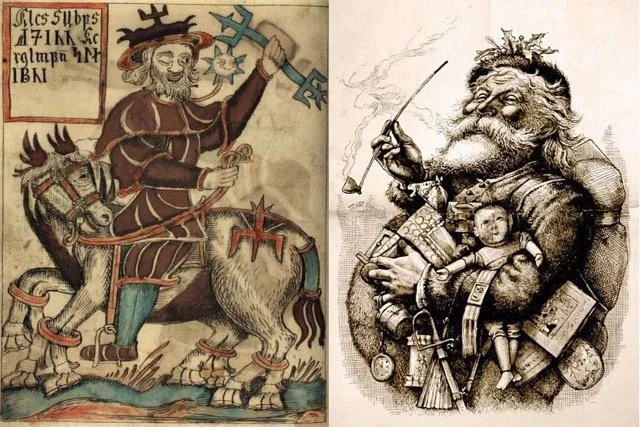
The myth: Santa was inspired by the god Odin
The Norse god Odin rode a flying horse, had a white beard, and filled children’s shoes with treats during his “wild hunt” every winter. That sounds a little like Santa, right? Flying around at night, giving gifts to children?
Again, conflation doesn’t lead to correlation.
The first depiction of a white-bearded, red-suited Santa appeared in Harper’s Weekly in 1863, about forty years after the publication of the poem “A Visit from St. Nicholas” by C. Clement Moore. While the poem depicts Santa as an “elf,” he was “jolly,” smoked a pipe, and had magic powers. His sleigh and reindeer were “tiny.” Coke co-opted Harper’s image for its advertisements in 1931, and the image stuck. None of this sounds very Norse godlike.
In fact, the origins of Santa Claus are entirely Christian. St. Nicholas was a 4th century Christian from Turkey, possibly a bishop, famous for giving gifts to poor children by tossing them through windows and filling stockings drying by a fire. The tradition of gift-giving on his feast day, December 6, took root in Europe, where the Dutch refer to him as “Sinterklaas” –the name literally means “Saint Nicholas.” This tradition travelled to America with Dutch settlers, and the name eventually evolved into “Santa Claus.”
Incidentally, “Kris Kringle,” another name commonly used for Santa Claus, really has nothing to do with Santa at all. It originated as the German Christkindlein meaning “Christ Child.” It’s hard to say how that name became entwined with Santa, but it definitely didn’t come from paganism.
Myth: Kissing under the mistletoe was a pagan ritual
While ancient peoples used mistletoe for its medicinal benefits, and mistletoe does figure prominently in some Norse legends, there is no pagan tradition of kissing under the mistletoe. That tradition originated in the 18th century, inspired by a popular song.
What all the men, Jem, John, and Joe, / Cry, ‘What good-luck has sent ye?’ / And kiss beneath the mistletoe. / The girl not turn’d of twenty.”
It has nothing to do with Christmas, other than being used as a decoration in European houses around Christmastime because, like Christmas trees, it was an evergreen with attractive berries.
Myth: Hanging stockings originated with the Norse god Odin
As mentioned earlier, the Norse god Odin went hunting during the winter on a flying horse. Children would leave their shoes out with treats for the horse (flying is hard work), and Odin would thank them by replacing the treats with gifts for the kids. But there is no mention of stockings in this story.
Our tradition of hanging stockings originated, again, with Saint Nicholas. To provide dowries for the daughters of a poor man, Nick put gold coins in their stockings while they were hanging by the fire to dry. No mention of shoes or flying horses.
The common practice of hanging stockings did not become widespread until the publication of “A Visit from Saint Nicholas” in 1823.
Myth: Flying reindeer are pagan
Many pagan myths indeed include flying animals. But then, there are flying animals in the Bible, too. Wasn’t Elijah taken to heaven on a chariot of fire?
Besides, reindeer did not become associated with Santa Claus until 1821 in an anonymously written booklet published by William Gilley. It’s possible the author got the idea from Scandinavian tales of reindeer, but we don’t know for sure, since the author was never identified. Two years later, A Visit from Saint Nicholas was published, naming the reindeer for posterity.
Myth: Yule, a pagan festival, became Christmas
“Yule” was a Norse festival that took place during the winter solstice, entirely separate from Christmas. As Norse and Germanic people became Christianized, they referred to Christmastime as Yuletide, because the festivals fell around the same time. But that didn’t happen until the 9th century, long after Christmas was firmly established as a Christian holiday.
But Christmas isn’t in the Bible…
Still, many people will say we should not celebrate Christmas because the Bible does not command it. Jesus specified one way to commemorate him: the Last Supper. What we now call Holy Communion.
The Old Testament recognizes seven festivals: Passover, Unleavened Bread, Firstfruits, Weeks (Pentecost), Trumpets (Rosh Hashanah), Day of Atonement (Yom Kippur), and Tabernacles (Sukkot).
Note that Hanukkah is not on this list—the Festival of Lights was celebrated to commemorate the Maccabees' victory over the Seleucid invaders during the intertestamental period. Also, Purim, the holiday commemorating the deliverance of the Jews from genocide in the Book of Esther, is not among these seven ordained festivals either. Yet both festivals are part of the Jewish calendar.
So, is celebrating Christmas acceptable to God?
Paul says, “One person considers one day more sacred than another; another considers every day alike. Each of them should be fully convinced in their own mind. Whoever regards one day as special does so to the Lord.” (Romans 14:5–6).
I think what Paul is saying is that any way of glorifying and proclaiming the name of Jesus is acceptable to the Lord.
Many people who don’t attend church the rest of the year go to church at Christmastime. What an awesome opportunity to proclaim Jesus Christ to those who have not encountered Him. I have written many Christmas plays and musicals for my church through the years because I believe people are more receptive to the message of Christ at Christmastime. People want more from Christmas than sales and marketing. They want to understand the meaning of Christmas: that Christ came to earth to save us. That God so loved the world, He sent His Son to die for us. (John 3:16)
So whether or not you celebrate Christmas, you can always celebrate Christ and use every opportunity to tell people about Him. That is, after all, what He told us to do.
“Therefore go and make disciples of all nations, baptizing them in the name of the Father and of the Son and of the Holy Spirit, and teaching them to obey everything I have commanded you. And surely I am with you always, to the very end of the age.”
Matt 28:19-20